Container unloading is the hardest job on the dock. It’s hot inside a steel box, the boxes are heavy, the stacks are unpredictable, and the pace is relentless. Workers know this before day two. That’s why crews don’t stay.
According to OPSdesign’s June 2025 analysis of warehouse labor trends, annual turnover rates can exceed 40% in some facilities. TAWI’s 2026 container unloading report puts it plainly: labor shortages and physical demands remain the defining challenge in container unloading this year. For operations managers, this isn’t a workforce strategy problem. It’s a throughput problem. Every time a crew turns over, a day or more of productive unloading capacity walks out the door.
Mixed carton sizes make every rotation worse. When box geometry changes from container to container, different heights, weights, orientations, wrapping conditions, a new worker can’t develop consistent technique. Veterans take twice as long to train crews on variable loads. Rework and restacking climb. Dock utilization drops. The problem compounds itself.
Why fixed automation fails on mixed box sizes
The instinct to replace manual labor with traditional automation is right. The execution usually isn’t.
Conventional container unloading robots and fixed conveyor systems require pre-mapped configurations. They need to know where boxes will be, roughly what size they’ll be, and how they’ll be stacked before the first carton moves. In practice, that means they only work reliably on single-SKU, highly consistent loads, a narrow slice of real dock work.
When a mixed-SKU container arrives with irregular stacking patterns or damaged packaging, the system stops. An engineer gets called. A changeover happens. Downtime accumulates. The facility ends up managing two problems instead of one: the original labor gap, plus an automation system that needs babysitting. Variability isn’t an edge case in container unloading. It’s the default state of the job.
The limits of traditional 3PL automation are well documented: systems built for a controlled environment fail in operations where no two loads match.
What a turnover-resistant solution must do
If you’re evaluating a container unloading robot to reduce dependence on crew consistency, it needs to meet a specific set of requirements:
- Generalize across carton sizes and stacking configurations without pre-mapping
- Deploy at existing dock doors with no facility redesign
- Get up and running in hours, not months
- Operate without operator intervention between loads
- Improve over time through on-the-job learning
The metrics that matter: containers unloaded per shift, labor hours per container, rework and restacking incidents, and how long it takes to start the next load after a crew change (ideally, zero, the robot doesn’t care).
How Servo7 handles mixed cartons at the dock door
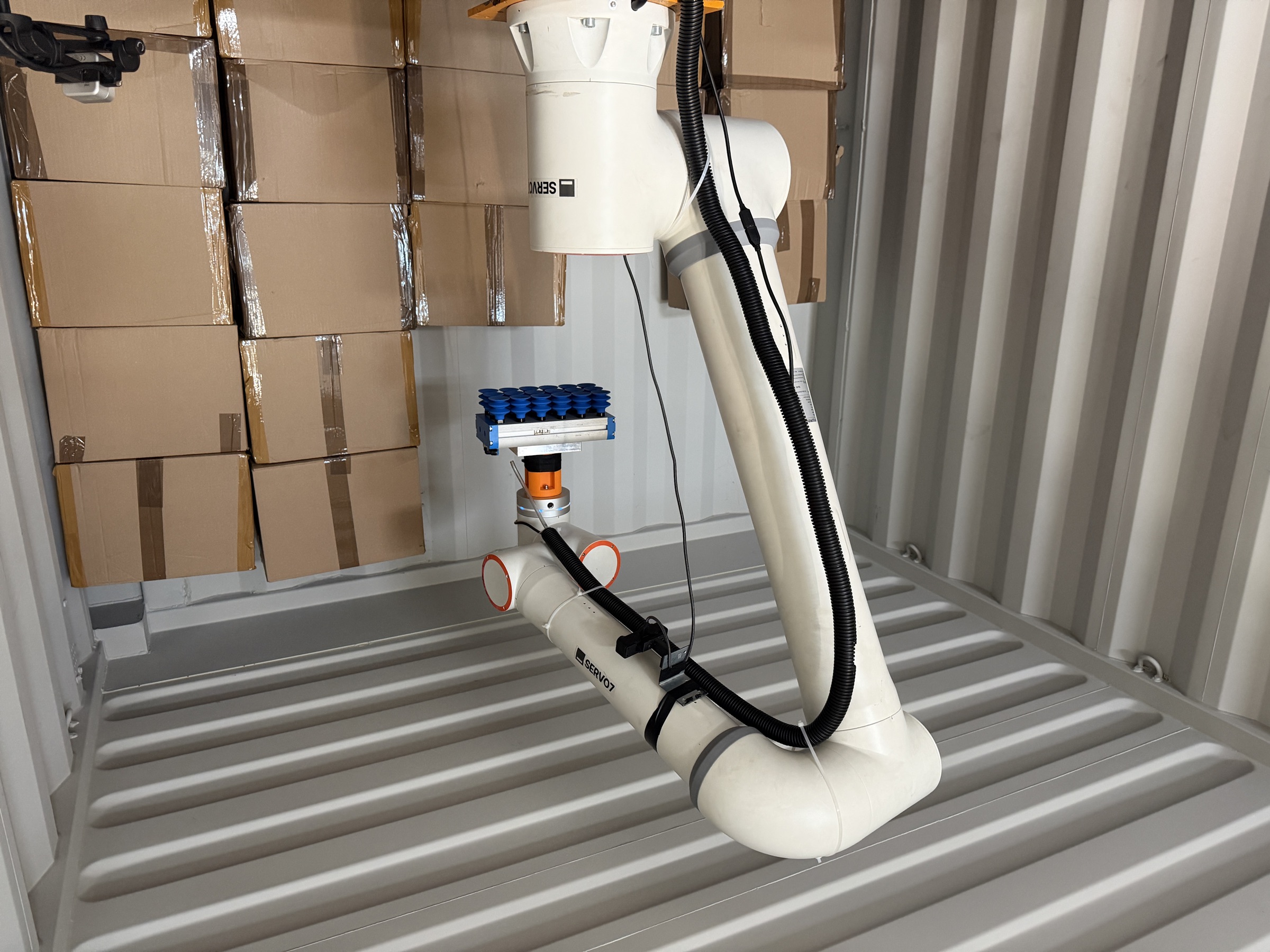
Servo7’s Mammoth robot was built specifically for loose-loaded shipping container unloading, the kind where no two loads are the same. It uses real-time container reading and AI vision to identify carton geometry and stack configuration on the fly, without a pre-mapped load profile.
Setup takes roughly 45 minutes at an existing dock door. No facility redesign, no engineering project, no frozen floor plan. Task definition happens through demonstration: show the robot the task, and it learns. There’s no code to write. After that, Mammoth unloads autonomously, outputting to a conveyor or pallet depending on what your material flow requires.
The performance numbers: end-to-end unloading of a loose-loaded container in under 2.5 hours, with single-SKU runs completing in under 2 hours. Payload capacity is 23 kg per carton. No operator intervention is needed between loads, which means when a crew member doesn’t show up, nothing changes about your output.
For a closer look at how the AI learns and adapts, the skill segmentation approach explains how the system assigns the right control method to each subtask based on variability and object characteristics.
Implementation playbook: your first stable container run
Getting started doesn’t require a 6-month integration. Here’s the practical sequence:
- Define your output target. Choose conveyor or pallet output based on your downstream flow. Set a throughput goal (containers per shift or per day) as your acceptance benchmark.
- Run a demonstration session. With demonstration-based training, task definition takes a single session. The robot observes, learns, and confirms readiness. No coding, no configuration files.
- Run a baseline-vs-pilot comparison. Measure labor hours per container, time to unload, downtime events, and rework before and during the pilot. These numbers tell you your payback story.
- Scale across doors. Once a single door is stable, multi-unit deployment across the facility doesn’t require proportional overhead. The learning carries over.
What your team needs to provide: confirmed dock access and door dimensions, a sample of your carton variability (the messier the mix, the better), a safety review against your standard dock protocols, and agreed acceptance criteria before the pilot starts.
The container unloading field insights report covers real operator feedback from facilities dealing with exactly this configuration variability.
ROI framework: what turnover costs you
Turnover in container unloading roles carries costs that don’t always show up on a single line item. A transparent estimate needs four inputs:
| Cost category | Typical driver |
|---|---|
| Baseline labor cost per container | Crew hours × hourly rate (or flat lumper fee) |
| Turnover-driven training cost | Onboarding hours × supervisor/trainer rate, per rotation |
| Productivity loss during ramp-up | Throughput delta × days to full productivity × containers/day |
| Rework and downtime | Restacking incidents × labor cost per event |
Once you have annual container volume and weekly labor cost, the payback on dock-door automation becomes a straightforward calculation. TAWI’s 2026 container unloading analysis puts ROI for semi-automated unloading equipment at 12 to 24 months under typical conditions. Servo7’s approach targets a tighter payback window by cutting setup overhead and eliminating the engineering cost of traditional deployment.
The container unloading ROI calculator on Servo7’s site lets you run your own numbers using either hourly labor rates or flat contractor fees. It’s the fastest way to validate fit before committing to a pilot.
For a broader look at what automation ROI calculations typically miss, the ROI analysis for automation breaks down the hidden costs that make payback periods look longer than they are.
Safety and the physical cost of dock work
The U.S. Bureau of Labor Statistics classifies hand laborers and material movers among the occupational groups with the highest rates of musculoskeletal strain. Container unloading amplifies this: workers bend, twist, and lift repeatedly in a confined, often hot environment for hours at a stretch. Physical strain is more than a safety concern, it’s the primary reason experienced workers leave and the primary barrier to retaining new hires long enough to build proficiency.
When a robot handles the repetitive heavy lifting, the human role shifts. Workers who remain on the dock aren’t lifting 23 kg cartons hundreds of times per shift. That changes the sustainability of the role and, over time, the turnover math.
See where robots make operational sense for a grounded assessment of which dock tasks are genuinely automatable today vs. which still require human judgment.
FAQ: what operators and automation engineers ask
Yes. Mammoth reads the container in real time using AI vision. It doesn’t need a load profile or pre-configured stack map. Mixed SKU and single-SKU containers both run without reconfiguration.
Initial robot setup takes approximately 45 minutes at your existing dock door. There’s no facility redesign and no civil work required.
The system uses real-time carton recognition, so it responds to what it sees rather than what it expects. Damaged cartons that fall outside handling parameters are flagged for human review rather than forcing a system stop.
No. Task definition happens through demonstration, not code. Ongoing operation doesn’t require a resident automation engineer.
Pilot length is flexible. Acceptance criteria are set before the run starts, typically containers per shift, labor hours per container, and downtime events. Servo7 offers a money-back guarantee and guaranteed output support during the pilot.
Mammoth outputs to conveyor or pallet, depending on your downstream flow. Both options are supported without hardware changes.
For more on training AI robots through demonstration, including what happens when the robot encounters a task it hasn’t seen before, the technical overview covers the learning process in plain terms.
Run your first pilot on your container mix
If your unloading operation runs on crews that change weekly and containers that never stack the same way twice, the answer isn’t a faster onboarding program. It’s removing the dependency on crew consistency entirely.
Servo7 is designed for exactly this scenario. Bring your messiest container mix to the pilot. Define the throughput target. Measure the result. If the numbers don’t work, the guarantee is the safety net.
Run a pilot at your dock door.
Bring your messiest container mix. Set the throughput target. Measure the result.