If you manage inbound freight at a facility that receives loose-loaded ocean containers, you already know this pain: your dock crew spends two, three, sometimes four hours per box-by-box. Backs bent, cartons dropped, trucks queued outside waiting for a door to open. And finding reliable people willing to do it again tomorrow? Getting harder every quarter.
The question most operators ask at this point is: “Can we automate this, and how fast can we get there?” This post gives you a straight answer, plus a practical playbook you can use to evaluate your options and move quickly.
Why floor-loaded containers break conventional automation
A palletized load is predictable. A floor-loaded container is not. Every carton arrives in a different position, a different orientation, and a different stack configuration. Mixed box sizes within a single container are common. Irregular stacking, whether from the shipper’s packing crew or the reality of ocean transit, is the rule, not the exception.
That variability is exactly what defeats traditional fixed automation. Conveyor-belt systems and rigid robot arms rely on knowing where things are before they reach the pick point. Pre-mapped configurations require your incoming freight to behave consistently. It won’t. The result is either a system that jams constantly, or one that gets abandoned after the pilot and never scales.
This isn’t a small operational nuisance. It ties directly to KPIs that cost real money: dock door utilization, labor hours per container, injury frequency, and inbound dwell time. The National Employment Law Project reported in May 2023 that warehouse workers experience injuries at a rate of 6.5 cases per 100 workers. WorkSafe Victoria’s archived safety guidance specifically identifies loading and unloading tasks as high-risk for shoulder, back, and knee injuries. Those aren’t abstract statistics, that’s your crew, your workers’ comp, and your turnover rate.
For more context on what makes this the toughest job on the dock, the container unloading field insights report from Servo7 is worth a read.
”Fastest” compared to what? Define your KPIs first
Before choosing an automation approach, you need a sharper evaluation lens than “it moves boxes faster.” The metrics that matter at the dock level are:
- Elapsed time per container (from truck docking to doors closed and truck released)
- Cases per hour (robot pick rate, not peak advertised speed)
- Setup and changeover time (how long before the first carton moves, and between containers)
- Labor hours per container (FTE cost per run, including supervisory time)
- Damage rate during destuffing
- System availability during peak receiving windows
Setup time is where most automation solutions quietly lose the race. A system that picks at 800 cartons/hour but takes 90 minutes to configure for each new container isn’t saving you dock time. It’s moving the bottleneck upstream.
Why most automation approaches stall out
The failure modes are predictable once you’ve seen a few projects. Pre-mapped task configurations require your inbound freight to be consistent. It isn’t. Long integration schedules, often 6 to 18 months for fixed conveyor and gantry systems, assume stable facility layouts and engineering resources that most operations don’t have. And systems built for controlled environments simply don’t survive contact with real-world loose-loaded variability.
The ProMat 2023 showcase, covered by The New Warehouse in April 2023, featured multiple automated trailer unloading systems and illustrated how fragmented the market still is. DHL has deployed Boston Dynamics Stretch for container unloading, as reported by Progressive Robotics in June 2026. But large-operator deployments don’t automatically translate into “fast path” options for mid-size or high-variability operations.
The honest read on traditional automation’s limitations is that it was built for predictability. Most dock environments don’t offer that.
The fastest way: real-time AI that reads the actual load
The approach that delivers fast results at the dock door combines three things: real-time container reading (the system sees and adapts to whatever is in the container), AI-based task adaptation (no pre-mapping required for each new load), and output to your existing downstream infrastructure, whether that’s a conveyor or a pallet.
That last point matters more than it sounds. You don’t need to redesign your warehouse. You need a system that docks to your existing door interface and hands off to whatever conveyance you already have.
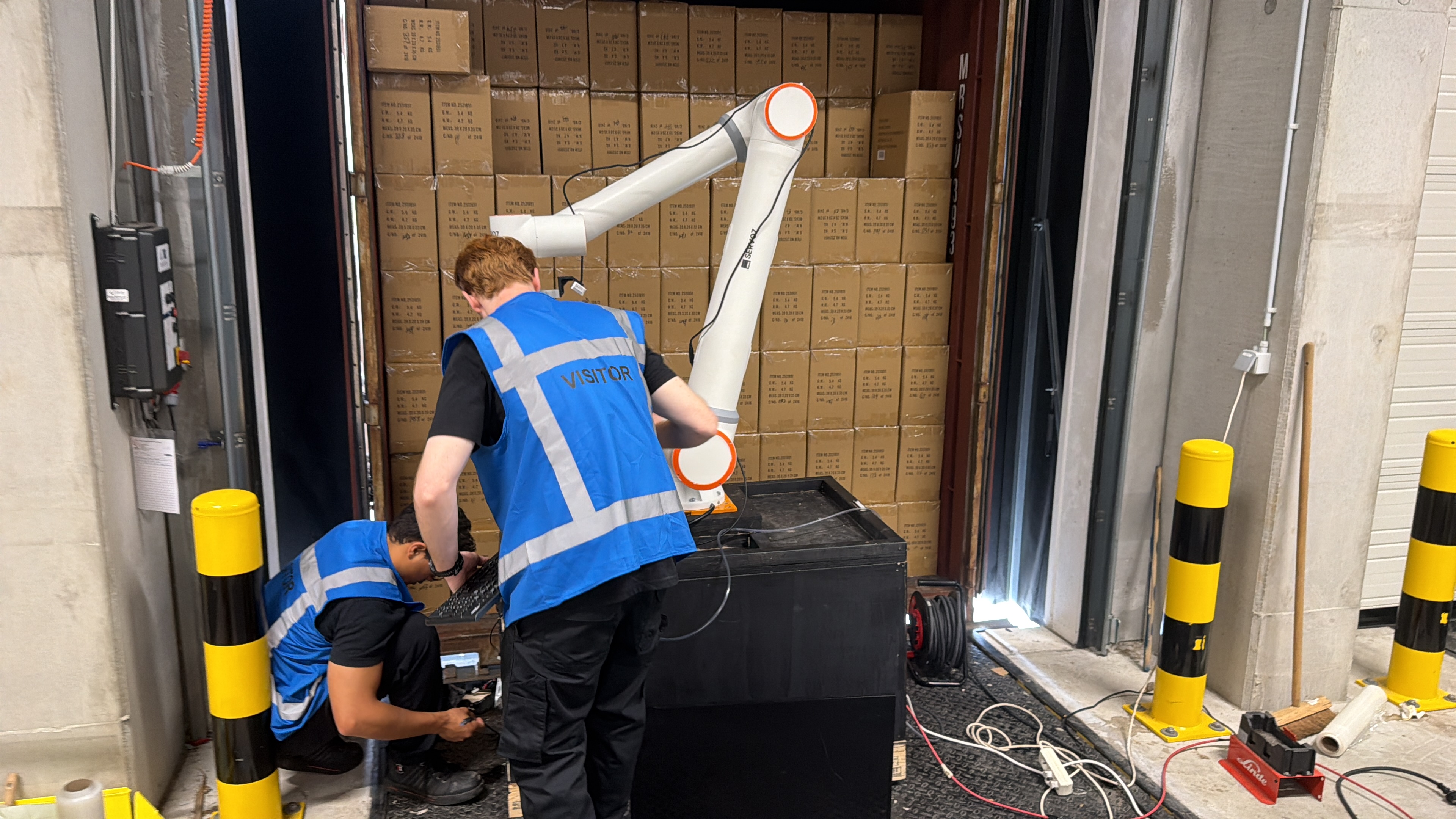
Servo7’s container unloading robot is built around exactly this architecture. It handles any box, any stack configuration, up to 23 kg payload per carton, and completes a full loose-loaded container in under 2.5 hours. Single-SKU runs come in under 2 hours. The system requires no pre-mapped configurations, it reads the container in real time and adapts continuously. No operator intervention needed between loads.
Understanding how AI warehouse robots learn helps clarify why this flexibility is possible: one end-to-end model replaces the separate vision, planning, and control layers that make traditional robots brittle.
Implementation playbook: 45 minutes to first container run
Here’s what “fast” looks like in practice:
Step 1: Define the task by demonstration. An operator shows the system what the unloading task looks like in your specific dock environment. No code. No engineering project. IT doesn’t need to be in the room. This is the core of demonstration-based training, the robot learns from watching, not from being programmed.
Step 2: Validate on the dock. Run the first container and measure against your KPI baseline. What are you tracking? Elapsed time per container, cartons per hour, and any damage incidents. This is your pilot data.
Step 3: Standardize and scale. Adding doors doesn’t mean repeating an engineering project. The configuration that works at door 3 carries over. What changes is physical deployment, what stays the same is the learning the system has already done.
Quick site readiness checklist:
- Dock door with standard trailer/container interface
- Safety zoning established around the unloading area
- Downstream conveyance or pallet staging confirmed
- Basic data connectivity (network access for monitoring)
Initial robot setup: approximately 45 minutes. That’s the number Servo7 targets, and it’s achievable because the system doesn’t need facility modifications to get started.
How to compare your automation options
Here’s a practical decision matrix for procurement:
| Modality | Handles mixed-SKU / irregular stacking | Pre-mapping required | Setup/integration effort | Safety/ergonomics impact | Throughput potential |
|---|---|---|---|---|---|
| AI-powered mobile unloader (e.g., Servo7) | Yes | No | Low (45 min setup) | High (removes workers from trailer) | Under 2.5 hrs/container |
| Articulated arm / fixed gantry | Partial (needs consistency) | Yes | High (months) | Medium | Variable by config |
| Telescopic / accordion conveyor | No (labor-assisted) | N/A | Low-Medium | Low-Medium | Depends on crew |
| Manual / powered pallet jack | No | N/A | None | Low (high injury risk) | 2-4+ hrs/container, variable |
Best fit guidance: If your inbound is highly variable imports with mixed box sizes and irregular stacking, the AI-powered mobile unloader is your fastest path. If your SKU mix is narrow and stacking is highly consistent, a fixed conveyor-assisted approach may be viable. If you’re running fewer than one container per day, manual with ergonomic assist equipment may still be sufficient, though the ROI calculation on automation often surprises operators who haven’t modeled it carefully.
Safety and labor: the two reasons this decision is accelerating
The labor market for physically demanding dock roles isn’t recovering. It’s tightening. The work is exhausting, injury rates are high, and turnover in unloading positions is among the worst in any warehouse operation. Automation removes workers from inside trailers and containers entirely, eliminating the posture-stress and repetitive-lift risk that WorkSafe Victoria’s guidance and the National Employment Law Project’s data describe in detail.
Practical safety planning items when deploying dock automation:
- Define and mark the robot’s operating zone clearly
- Train remaining personnel on proximity protocols
- Apply standard lockout/tagout procedures for maintenance
- Confirm safety sensor coverage matches your dock layout
The safety case and the labor case point in the same direction. If you can automate this task without a major engineering project, you should.
The built to automate the heavy lifting piece explores what operators told Servo7 directly about why this role is so hard to staff.
ROI model: what makes payback fast at the dock door
The ROI drivers for dock-door container unloading automation are straightforward:
- Labor hours saved per container (2-4 FTE hours, every run)
- Reduced overtime during peak receiving
- Faster dock door turnover (more containers per door per day)
- Reduced product damage during destuffing
- Elimination of injuries and associated costs
Worked example (adapt inputs to your operation):
Assume 5 containers/day, 250 operating days/year = 1,250 containers annually. At 3 labor hours per container with 2 workers at $22/hour fully loaded, that’s $165,000/year in direct unloading labor. Add overtime, turnover costs, and any damage/rework, and the real number is higher. A system that cuts elapsed time per container from 3+ hours to under 2.5 hours while reducing the crew from 2 workers to 1 supervisor generates material savings in year one.
The critical distinction: robot cycle time is not the same as docked throughput impact. The metric that matters is total elapsed time from truck docking to door clear, including setup, the run itself, and cleanup. That’s where you recover dock capacity.
Use the container unloading ROI calculator to model your specific numbers.
FAQs
Yes. The only requirements are a standard dock door interface, safety zoning, and existing downstream conveyance or pallet staging. No structural changes needed.
With demonstration-based training and a ready dock, approximately 45 minutes to initial setup and first run. Pilot validation typically spans a short period on your own containers.
Yes. Real-time container reading means the system adapts to whatever is in the container. It doesn’t need consistent stacking or uniform box sizes to operate.
Peak receiving is exactly when dock automation delivers the most value. Systems built for dock deployment are designed to run continuously without intervention between loads. Maintenance protocols follow standard industrial robotics practice.
The learning and configuration from door one carries over. Scaling is a physical deployment question, not a new engineering project. Multi-unit deployment across facilities follows the same pattern.
Ready to run your first container?
If you’re unloading loose-loaded containers today with manual crews, or with automation that demands too much setup time per load, the fastest path forward is a pilot on your own freight. Bring your messiest containers, set the acceptance criteria in advance, and measure the result against your manual baseline.
See it run at your dock door.
Setup in 45 minutes. First container the same day. Money-back guarantee on the pilot.