Most robot integration projects run long for a predictable set of reasons: the site wasn’t ready, the safety documentation wasn’t started early enough, and nobody agreed on what “go-live” actually meant before commissioning began. According to roboticscenter.ai, the four most common stall points are site readiness, safety paperwork, system setup, and final testing. None of them are technical surprises. All of them can be controlled upfront.
This guide exists to help operations teams do exactly that, specifically for container unloading robots deployed at the dock door, where the process involves loose-loaded cartons in variable sizes and stacking patterns. If you’ve been told this type of automation requires a long engineering project, this playbook will show you where that assumption breaks down.
Why integration projects run longer than expected
The conventional robotics deployment model was designed for controlled environments: fixed conveyor layouts, known SKU dimensions, and consistent load patterns. Container unloading doesn’t fit that model. Every incoming container is different. Box sizes vary, stacking heights shift, and load integrity changes between shipments. Systems that rely on pre-mapped configurations stall immediately because you can’t pre-map what you haven’t seen yet.
That mismatch between system design and operational reality is what creates long projects. The integrator has to account for every edge case upfront, which means extended discovery phases, custom software work, and site modifications that weren’t in the original scope.
The better approach: pilot first on real inbound conditions, then commission. The goal is time-to-value, not a perfect system on paper.
7 things to confirm before you sign (to protect your timeline)
These aren’t nice-to-haves. Each one is a potential timeline killer if left unresolved.
- Dock-door and floor readiness. Confirm usable footprint at the target door, safe egress routes, and any floor-level constraints (drains, slopes, transition plates) that could block commissioning or limit robot positioning.
- Box variability scope. Define what “loose-loaded” actually means in your inbound mix: dimensions, weight range, stacking irregularities, and any damaged or taped packaging that shows up regularly.
- Throughput target. Establish what success looks like in your operation: containers per day, shifts per door, and average dwell time tolerance. Vague targets produce unresolvable go/no-go debates later.
- Conveyor or pallet output interface. Identify where cartons need to go after the robot handles them. Conveyor height, electrical supply, and any PLC handshake requirements need to be confirmed before install, not during it.
- Safety approach. Agree on who completes the risk assessment and who signs off on safeguarding. ISO 10218 and ISO/TS 15066:2016 provide the foundational requirements for collaborative industrial robot deployments, including safe human-robot contact conditions. Both standards should be part of your pre-contract conversation with any vendor.
- WMS/ERP integration scope. For most dock-door deployments, the minimum necessary integration is the task layer (where does the robot operate, what does it output) rather than a full bidirectional WMS data flow. Integration for warehouse automation is often described as requiring real-time status updates between robots and WMS/MES/ERP (Smartlogistix), but that’s the full-scale picture. For launch, ask what’s required vs. what’s optional.
- Support and output guarantee. Confirm who owns pilot success: the vendor, an integrator, or your team. Vendors offering a guaranteed output commitment (including a fallback if targets aren’t met) reduce your risk significantly.
A deployment roadmap that avoids the “big project” trap
A phased approach keeps scope from expanding before you’ve validated the basics.
Phase 0 (prep, days 1-3): Assemble the right stakeholders (operations lead, safety officer, IT contact, and vendor project manager). Capture baseline KPIs: labor hours per container, average unload time, downtime events, and dock dwell cost. Document any site constraints identified in the pre-sign checklist above.
Phase 1 (pilot, days 4-7): Deploy on one door with your real inbound containers. This is a learning phase, not a performance test. The objective is to validate that the system handles your actual mix and establish a performance baseline. Demonstration-based robot training means you’re not writing custom code for each load configuration; you’re showing the system and it adapts.
Phase 2 (commissioning, days 8-14): Safety sign-off, repeatability validation, and structured acceptance testing. Every commissioning checklist should include electrical verification (wiring terminations, insulation resistance), network and data link confirmation, safety zone validation, interlock and emergency-stop testing, and documented sign-off (iFactory AI, June 2026). No go-live before this phase is complete.
Phase 3 (scale): Replicate across additional doors using the same onboarding sequence. Each subsequent deployment is faster than the first because the acceptance criteria are already documented.
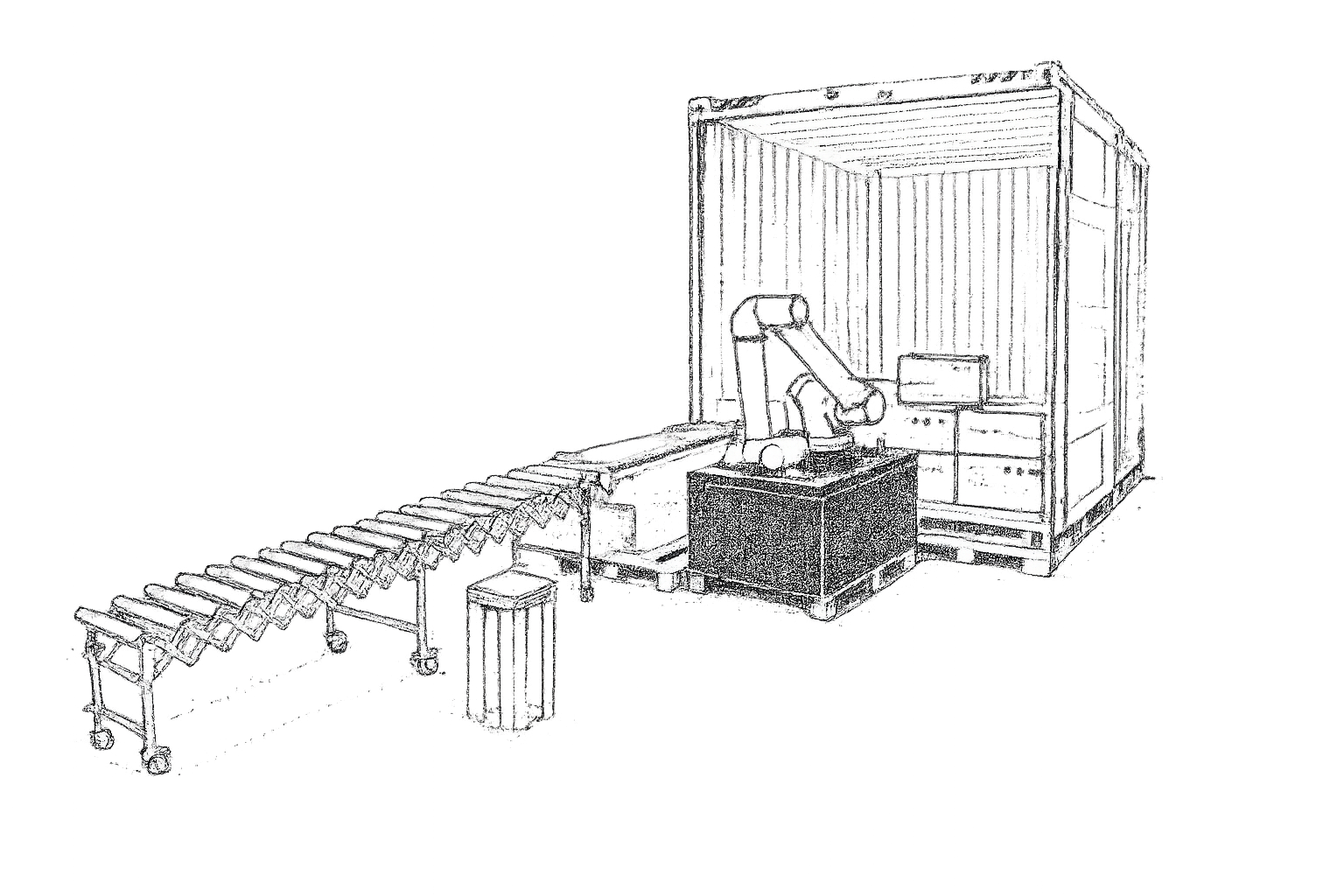
Servo7’s system, for instance, reaches initial setup at a dock door in approximately 45 minutes, with end-to-end unloading of a loose-loaded shipping container completed in under 2.5 hours. That kind of baseline makes Phase 1 a real pilot, not a weeks-long calibration exercise.
Integration, simplified
Most operations teams over-engineer the integration scope before they’ve run a single pilot. The minimum necessary integration for a dock-door unloading robot is:
- Task definition: what containers to process and in what sequence
- Output routing: conveyor feed confirmation or pallet drop signal
- Event logging: start time, end time, carton count, any operator interventions
WMS and ERP connections add value at scale (reduced manual data entry, real-time inventory signals), but they’re not required for a functional pilot. Protocols like OPC UA provide standardized, secure real-time communication between equipment and higher-level systems when you’re ready to connect (SG Systems Global), but that conversation belongs in Phase 3, not Phase 0.
Ask your vendor for interface control documents (ICDs) and data schemas before signing. If they can’t provide them, that’s a red flag for timeline risk. On the cybersecurity side: connected warehouse systems should separate OT from IT networks and use access controls and encrypted transmission, a standard practice reinforced by Datex’s 2025 warehousing cybersecurity guidance.
Safety and commissioning: the fastest path is the most structured path
Skipping steps in commissioning doesn’t save time. It creates rework. A risk-assessment-first workflow, completed before the system is powered on at your site, is the single highest-leverage action you can take to protect your go-live date.
Common commissioning delays include:
- Missing or incomplete wiring diagrams at the time of install
- Unclear responsibility for safety zone labeling (vendor vs. customer)
- Late changes to dock layout after the safeguarding design is finalized
- No pre-agreed acceptance criteria, so sign-off becomes a negotiation
Formal sign-off should happen before go-live is declared. That means tested, documented, and approved, not “running well enough.”
What to measure during the pilot
Opinions about performance are hard to resolve. Data isn’t. Track these during your pilot:
- Time-to-unload per container (actual, not theoretical)
- Time-to-stable performance: how many containers before the system reaches repeatable throughput
- Downtime taxonomy: robot stops, detection misses, operator interventions, conveyor or pallet interface failures
- Labor hours per container: before vs. during pilot (this is your primary ROI input)
- Uptime % and any recurring failure patterns
If you’re also tracking output completeness and reject rates, you’ll have everything needed for a clean go/no-go decision at the end of the pilot period.
ROI and time-to-value: a worked example
Assume your operation unloads 5 containers per day, 250 days per year (1,250 containers annually). Manual unloading takes 3 labor hours per container with 2 workers at $22/hour fully loaded. That’s $165,000/year in direct unloading labor. The ROI model for warehouse automation breaks down these inputs in more detail.
A robot that handles the same volume at the same dock doors, without overtime spikes during peak periods, eliminates or dramatically reduces that line item. Add reduced dock dwell cost (detained containers carry fees that vary by carrier but commonly range from $75 to $150/hour after free time), avoided injury-related costs, and reduced crew turnover expenses, and the container unloading ROI compounds quickly.
The go/no-go rule: if pilot labor hours per container drop by 60% or more and uptime exceeds 85%, scale. If not, diagnose before adding doors.
Common objections, addressed
“Will it work on our containers?” Systems that rely on pre-mapped configurations won’t. Systems built on real-time container reading and AI-based task adaptation handle variable carton stacking without requiring a known load plan. Servo7’s system processes any box and any stack without pre-mapped configurations, which is what makes brownfield dock-door deployment viable.
“Will it slow the dock?” That depends entirely on staging. One person managing container positioning and pallet moves is sufficient; the robot handles the unloading. With a sub-2.5-hour unload target, dock throughput is maintained or improved vs. manual crews.
“How much change management is involved?” One to two roles: an operator who stages containers and moves output, and a local contact who escalates technical issues. The vendor handles training, commissioning, and performance monitoring during the pilot period. For a closer look at how little heavy lifting is left for your crew, see built to automate the heavy lifting.
FAQ
With a system designed for dock-door deployment, initial robot setup runs roughly 45 minutes. The full pilot phase (setup through stable performance) should complete within one to two weeks at most.
You’ll need a site-specific risk assessment aligned with ISO 10218 and ISO/TS 15066:2016. The vendor should provide the robot’s conformity documentation; your safety officer or a third-party assessor completes the site-level risk assessment. Confirm this split of responsibility before signing.
For brownfield dock-door deployments, no. The system should work within your existing door configuration. Confirm clearances and floor conditions in Phase 0 and you won’t be surprised in Phase 2.
The robot outputs to a conveyor or pallet. Physical interface requirements (conveyor height, electrical supply, any PLC signal handshake) need to be confirmed pre-install. This is a mechanical and electrical confirmation task, not a software project.
This is where the vendor’s support model matters. Servo7 backs its deployments with a guaranteed output commitment and a flexible test period, including a money-back guarantee if performance targets aren’t met. That kind of accountability changes the risk profile for operations teams evaluating the investment.
Ready to plan your pilot?
If you’re ready to stop estimating and start with a structured assessment of your dock, inbound mix, and output routing, get in touch with Servo7 for a fast-integration readiness review. Bring one real container’s specs, or share photos from a recent unload. That’s enough to build a realistic pilot plan with a timeline and deliverables.
Get a fast-integration readiness review.
Setup in 45 minutes. First container the same day. Money-back guarantee on the pilot.